Subsurface interception
French Drain Installation in Birmingham, AL
A French drain is a gravel-filled trench with a perforated pipe in it. Its job is to intercept water moving through and across the soil and carry it somewhere safe.
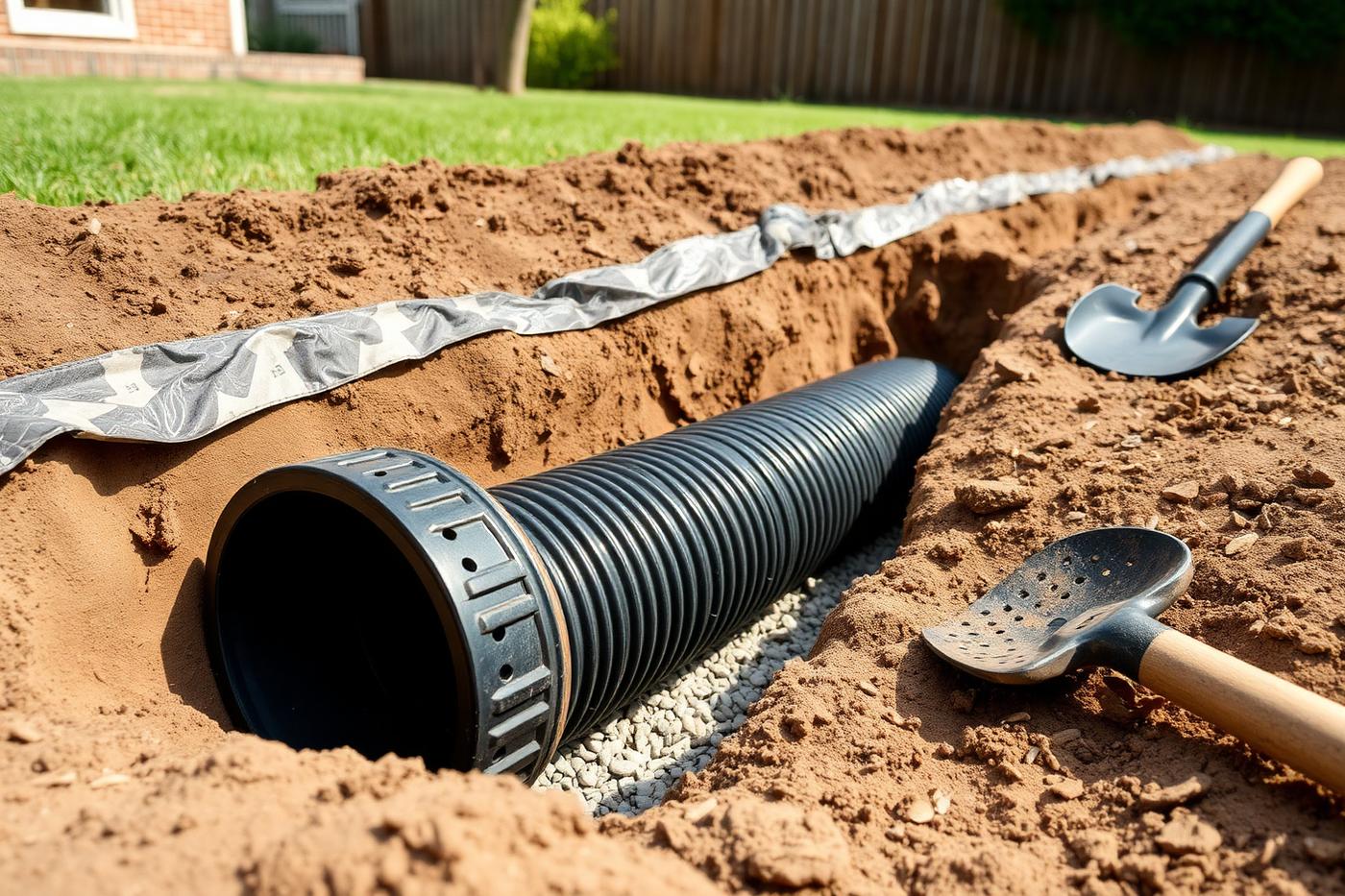
The parts are simple: a trench cut on a consistent fall, filter fabric, washed aggregate, and perforated pipe set so water can enter along the entire run. Water in the surrounding soil takes the path of least resistance, which is the gravel, and then travels down the pipe to a discharge point.
What separates a working French drain from a failed one is rarely the pipe. It is slope, aggregate quality, fabric placement and — above everything — whether the outlet is actually lower than the drain and free to release water.
Diagnosis
What makes French drains fail
Insufficient fall
Without continuous slope toward the outlet, the trench becomes a storage tank instead of a drain.
Fine material intrusion
Aggregate placed without proper fabric separation silts up and the void space disappears.
Wrong pipe or wrong orientation
Perforations, pipe type and bedding all affect how water actually enters the line.
No real outlet
A drain that terminates in a flat area or a buried void with nowhere to go will back up.
Symptoms
When a French drain is usually the right call
- Water seeps out of a slope and keeps the ground below it wet
- A long band of lawn stays saturated rather than one round puddle
- Water moves toward the house from higher ground
- A crawl space or foundation edge stays damp after storms
- Runoff crosses the yard from an uphill property
Birmingham Metro
Birmingham considerations
Dense clay-loam soil holds water at the surface longer, which means a French drain here often relies on capturing water above and within the top layers rather than on deep infiltration.
On sloped metro lots, the elevation drop that makes drainage design possible is usually available — the harder question is where the discharge can legally and safely daylight without moving the problem downhill onto someone else.
Process
Installation sequence
1. Layout and fall check
The route is set between the wet zone and the lowest usable discharge point.
2. Excavation
The trench is cut to depth with consistent slope maintained along the entire run.
3. Fabric and bedding
Filter fabric lines the trench and a bedding layer of washed stone is placed.
4. Pipe placement
Perforated pipe is laid and connected to solid pipe where the line runs to the outlet.
5. Backfill and finish
Aggregate is placed over the pipe, fabric is folded over, and the surface is finished in stone or soil and sod.
Budget
What moves the price
Every project is priced on site conditions. These are the factors that push a project up or down within the estimated ranges in our Birmingham cost guide.
- Length of the run and trench depth
- Rock, roots or compacted layers encountered during excavation
- Aggregate volume and haul-off of spoil
- Solid pipe distance to the discharge point
- Crossing driveways, walks or irrigation lines
- Sod or hardscape restoration
Want a figure for your specific property? Submit the project details and they can be reviewed by a professional serving your area.
Request a Drainage EstimateHonest scoping
When another method may work better
- Water pooling on the surface in one spot is often handled better by a catch basin than by a full trench system.
- If the whole problem is a downspout dumping beside the house, buried downspout drainage is the cheaper and more direct answer.
- If the yard slopes back toward the home, regrading may resolve the cause instead of managing the symptom.
- On driveways and hardscape, a channel drain captures sheet flow that a subsurface trench never sees.
Questions
Frequently asked
Typical residential runs are estimated in the $1,500–$6,000+ range, with larger multi-run systems sometimes reaching $10,000 or more. All figures are estimates only; the cost guide explains the factors that move a project within that range.
Project request
Request Local Drainage Pricing
Two short steps. Share your ZIP code and the drainage problem, then your name and phone number so the request can be reviewed locally.
- ■No obligation and no cost to submit
- ■Takes less than a minute
- ■Your phone number is private form data